

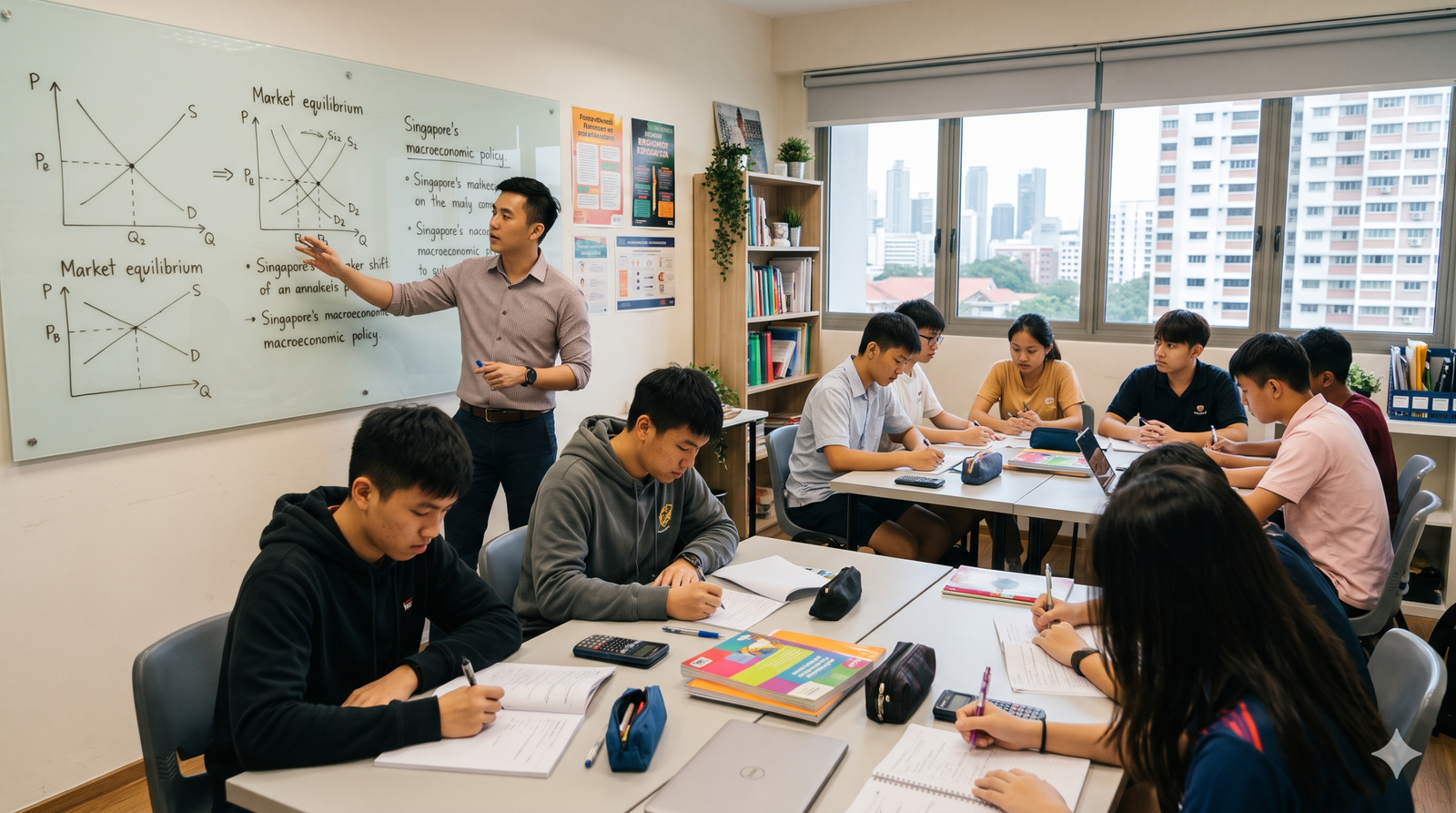
For JC (H1/H2) and IB students in Singapore, Economics is often a jarring shift from secondary school subjects. Mastering market failure, macroeconomic policies, case study data response, and essay evaluations requires specialized frameworks rather than rote memorization.
Selecting the right tuition centre depends heavily on learning preferences, target syllabus, and geographic accessibility across the island.
Comparison of the Top 5 Economics Tuition Centres in Singapore
| Centre | Principal / Lead Tutors | Curricula Covered | Key Locations | Standout Features |
| JC Economics Tuition | Anthony Fok | A-Level (H1/H2) | Bishan, Bukit Timah, Tampines | Ex-MOE teacher, regular media-featured educator, dedicated CSQ answering frameworks. |
| Economics Tuition Genius (ETG) | Eugene Toh | A-Level (H1/H2) | Bukit Timah, Sin Ming (Marymount) | Authored Ten-Year Series (TYS) answer keys; highly structured model essay compilations. |
| Economics Cafe | Edmund Quek | A-Level (H1/H2) | Bishan | Focus on diagrammatic precision, evaluation scaffolding, and extensive textbook resources. |
| Zenith Education Studio | Multi-tutor Team | A-Level (H1/H2) | Buona Vista, Potong Pasir, Tampines, Bishan | Holistic mentorship, 24/7 student consultations, youth-oriented teaching culture. |
| AceYourEcons (AYE) | Jeffrey Teo | A-Level (H1/H2) | Hougang / Central (plus hybrid digital) | Proprietary “ACE” framework designed to turn conceptual ideas into full-mark essays. |
Detailed Profiles
- JC Economics Tuition
Led by ex-MOE economics tutor Anthony Fok, JCEconomics.com is one of Singapore’s longest-running specialized centres.
- Pedagogy: Focuses heavily on the mechanics of Case Study Questions (CSQs) and higher-order evaluation marks (E1/E2/E3 bands) in H2 Economics essays.
- Best Suited For: Students who understand content at a high level but consistently struggle to finish papers on time or fail to address the question’s specific context.
Locations: Island wide coverage across Central (Bishan), East (Tampines), and West (Bukit Timah).
- Economics Tuition Genius (ETG)
Founded by Eugene Toh, ETG is recognized for its systematic, publication-backed approach.
Pedagogy: Instruction focuses on high-yield essay spotting, exam trends, and structured answering phrasing. The materials directly reflect official exam marking rubrics.
Best Suited For: Students needing clear step-by-step model templates and IB/A-Level candidates who prefer data-driven exam preparation.
Locations: Central/North (Sin Ming Road, Coronation Shopping Plaza).
- Economics Cafe
Founded by Edmund Quek, Economics Cafe is an MOE-registered tuition centre based in Bishan.
- Pedagogy: Mr Quek emphasizes deep micro and macroeconomic intuition before test drills. Lessons emphasize clean curve shifting, deadweight loss analysis, and real-world policy application.
- Best Suited For: JC1 students starting fresh or students needing conceptual clarity before moving to speed drills.
- Locations: Central (Bishan Street 11).
- Zenith Education Studio
Zenith operates modern hybrid centres across Singapore, catering to students seeking a dynamic environment.
- Pedagogy: Blends rigorous topical breakdowns with after-class academic support and curated cheat sheets.
- Best Suited For: Students who benefit from active classroom discussions, peer-driven environments, and on-demand tutor access outside regular hours.
- Locations: Hubs located across Buona Vista, Potong Pasir, Tampines, and Bishan.
- AceYourEcons (AYE)
AceYourEcons focuses on breaking down the syllabus into modular frameworks.
- Pedagogy: Uses the signature “ACE” structure to teach students how to deconstruct complex multi-part questions, identify command words, and apply contextual evaluative points systematically.
- Best Suited For: Students seeking structured logic systems to eliminate essay writing guesswork.
- Locations: North-East (Hougang) and on-demand digital modules.
How to Choose the Right Centre for Your Needs
- Diagnostic Trial: Attend a trial class or consultation to check whether you respond better to rapid-fire model essays (ETG, JCEconomics) or foundational concept reinforcement (Economics Cafe).
- Location & Travel Time: Given intense JC timetables, pick a centre on your direct train commute (e.g., Bishan for NSL/CCL commuters; Bukit Timah for DTL riders) to avoid burnout.
- Curriculum Alignment: If you take IB Economics rather than Singapore-Cambridge GCE A-Levels (H1/H2 9757/8823), ensure the centre specifically structures its rubrics around the IB Internal Assessment (IA) and HL paper requirements.
Frequently Asked Questions (FAQ)
What is the average cost of JC Economics tuition in Singapore?
Group tuition rates at reputable JC Economics centres typically range between S 520 per month (covering four 1.5 to 2-hour sessions), alongside an annual material/registration fee of approximately S 120. Private one-on-one tuition with experienced ex-MOE educators or full-time specialists ranges from S 150+ per hour.
What is the primary difference between H1 and H2 Economics tuition?
H1 Economics (Syllabus 8843) focuses exclusively on Case Study Questions (CSQ) covering two case studies (100% of the grade). In contrast, H2 Economics (Syllabus 9757) requires both Paper 1 (CSQs, 40%) and Paper 2 (three 25-mark essays, 60%). Tuition for H2 students dedicates substantial time to essay deconstruction, real-world context application, and synthesis/evaluation rubrics that H1 students do not require.
When is the best time for a JC student to start Economics tuition?
Most students benefit from enrolling either at the start of JC1 Term 2 (once foundational microeconomics concepts like price elasticity and market failure are introduced) or immediately after the JC1 Promotional Examinations. Waiting until the middle of JC2 often leaves insufficient time to correct structural essay deficiencies and diagram analysis under timed conditions.
Can centres catering to A-Level students also support IB Economics?
Not all centres support both. While core micro and macro concepts overlap, the International Baccalaureate (IB) syllabus requires distinct analytical frameworks for the Internal Assessment (IA commentary portfolio), Paper 1 (extended response), Paper 2 (data response), and Paper 3 (policy and quantitative evaluation for Higher Level). Centres like ETG provide dedicated IB tracks, whereas A-Level-exclusive centres focus strictly on SEAB/Cambridge rubrics.
Why do students who understand economic concepts still score C or D grades?
The most common hurdle in JC Economics is not concepting memorization, but application, context, and evaluation (Evaluation/EV marks). Cambridge examiners penalize generic “textbook regurgitation.” To secure an A grade, students must apply economic theories directly to the extract’s specific country profile, balance contrasting stakeholder viewpoints, and provide reasoned judgments regarding short-run versus long-run policy trade-offs.
Are physical classes better than online/hybrid lessons for Economics?
Physical classes allow real-time diagram drawing reviews and immediate feedback on essay outlines. However, hybrid and recorded classes are effective for independent learners who need to re-watch complex macroeconomic transmission mechanisms (such as interest rate channels and exchange rate adjustments) and fit lessons around demanding CCA schedules.



Leave a Reply